
description = "Ga -> Ga Ga Ga Ga, QED, amplitude, 1-loop";
If[ $FrontEnd === Null,
    $FeynCalcStartupMessages = False;
    Print[description];
  ];
If[ $Notebooks === False,
    $FeynCalcStartupMessages = False
  ];
LaunchKernels[4];
$LoadAddOns = {"FeynArts"};
<< FeynCalc`
$FAVerbose = 0;
$ParallelizeFeynCalc = True;
FCCheckVersion[10, 2, 0];
\text{FeynCalc }\;\text{10.2.0 (dev version, 2026-05-18 15:58:48 +02:00, 1a8e687c). For help, use the }\underline{\text{online} \;\text{documentation},}\;\text{ visit the }\underline{\text{forum}}\;\text{ and have a look at the supplied }\underline{\text{examples}.}\;\text{ The PDF-version of the manual can be downloaded }\underline{\text{here}.}
\text{If you use FeynCalc in your research, please evaluate FeynCalcHowToCite[] to learn how to cite this software.}
\text{Please keep in mind that the proper academic attribution of our work is crucial to ensure the future development of this package!}
\text{FeynArts }\;\text{3.12 (27 Mar 2025) patched for use with FeynCalc, for documentation see the }\underline{\text{manual}}\;\text{ or visit }\underline{\text{www}.\text{feynarts}.\text{de}.}
\text{If you use FeynArts in your research, please cite}
\text{ $\bullet $ T. Hahn, Comput. Phys. Commun., 140, 418-431, 2001, arXiv:hep-ph/0012260}
Nicer typesetting
FCAttachTypesettingRule[mu, "\[Mu]"];
FCAttachTypesettingRule[nu, "\[Nu]"];
FCAttachTypesettingRule[rho, "\[Rho]"];
FCAttachTypesettingRule[si, "\[Sigma]"];
FCAttachTypesettingRule[tau, "\[Tau]"];
FCAttachTypesettingRule[k1, {SubscriptBox, "k", "1"}];
FCAttachTypesettingRule[k2, {SubscriptBox, "k", "2"}];
FCAttachTypesettingRule[k3, {SubscriptBox, "k", "3"}];
FCAttachTypesettingRule[k4, {SubscriptBox, "k", "4"}];
FCAttachTypesettingRule[k5, {SubscriptBox, "k", "5"}];
diags = InsertFields[CreateTopologies[1, 1 -> 4],
{V[1]} -> {V[1], V[1], V[1], V[1]}, InsertionLevel -> {Particles},
ExcludeParticles -> {S[_], V[_], U[_], F[3 | 4], F[2, {2 | 3}]}];
Paint[diags, ColumnsXRows -> {4, 1}, Numbering -> Simple,
SheetHeader -> None, ImageSize -> {512, 256}];
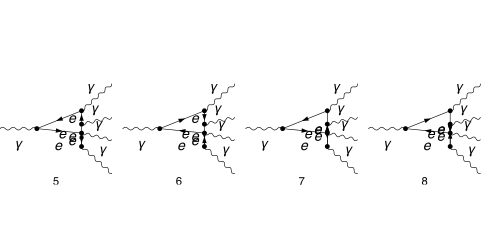
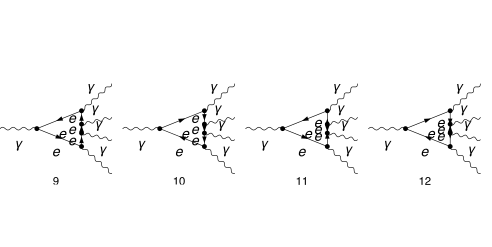

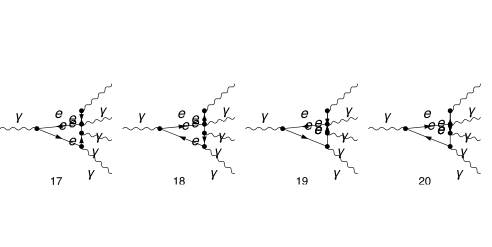
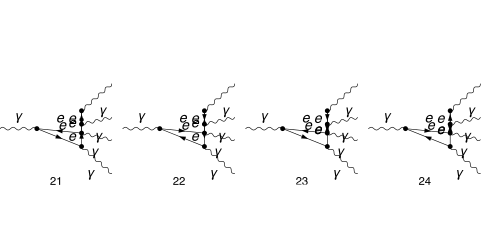
The 1/(2Pi)^D prefactor is implicit.
amp[0] = FCFAConvert[CreateFeynAmp[diags, PreFactor -> 1,
        Truncated -> True], IncomingMomenta -> {k1},
    OutgoingMomenta -> {k2, k3, k4, k5}, LoopMomenta -> {q},
    LorentzIndexNames -> {mu, nu, rho}, UndoChiralSplittings -> True,
ChangeDimension -> D, SMP -> True];We obtain 24 diagrams. The sum vanishes because the contribution of each odd diagram is exactly cancelled by the contribution of the next even diagram, i.e. A1+A2=0, A3+A4=0 and so on
amp[1] = FCTraceFactor[amp[0], FCParallelize -> True];res = amp[1] // Total0
```mathematica FCCompareResults[res, 0, Text -> {“Furry’s theorem for 5-photons at 1-loop:”, “CORRECT.”, “WRONG!”}, Interrupt -> {Hold[Quit[1]], Automatic}]; Print[“Time used:”, Round[N[TimeUsed[], 4], 0.001], ” s.”];
```mathematica
\text{$\backslash $tVerify Furry's theorem for 5-photons at 1-loop:} \;\text{CORRECT.}
\text{$\backslash $tCPU Time used: }51.702\text{ s.}