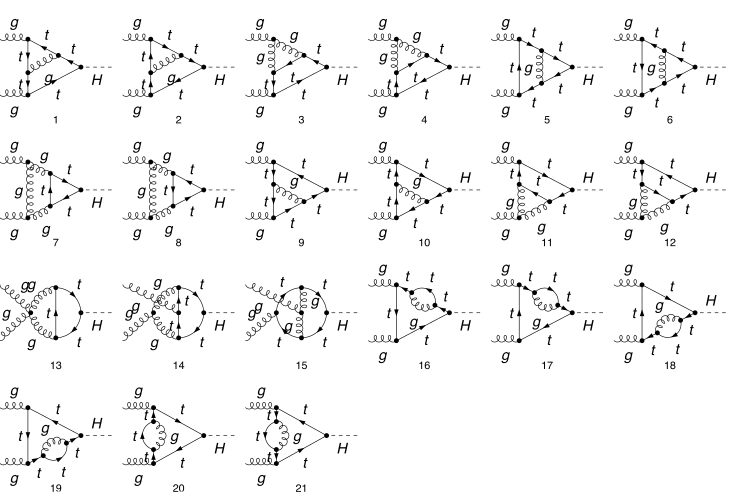
description = "Gl Gl -> H, QCD, 2-loops";
If[ $FrontEnd === Null,
    $FeynCalcStartupMessages = False;
    Print[description];
  ];
If[ $Notebooks === False,
    $FeynCalcStartupMessages = False
  ];
LaunchKernels[8];
$LoadAddOns = {"FeynArts", "FeynHelpers"};
<< FeynCalc`
$FAVerbose = 0;
$ParallelizeFeynCalc = True;

FCCheckVersion[10, 2, 0];
If[ToExpression[StringSplit[$FeynHelpersVersion, "."]][[1]] < 2,
    Print["You need at least FeynHelpers 2.0 to run this example."];
    Abort[];
 ]
\text{FeynCalc }\;\text{10.2.0 (dev version, 2026-05-18 14:09:14 +02:00, 9ab9d838). For help, use the }\underline{\text{online} \;\text{documentation},}\;\text{ visit the }\underline{\text{forum}}\;\text{ and have a look at the supplied }\underline{\text{examples}.}\;\text{ The PDF-version of the manual can be downloaded }\underline{\text{here}.}
\text{If you use FeynCalc in your research, please evaluate FeynCalcHowToCite[] to learn how to cite this software.}
\text{Please keep in mind that the proper academic attribution of our work is crucial to ensure the future development of this package!}
\text{FeynArts }\;\text{3.12 (27 Mar 2025) patched for use with FeynCalc, for documentation see the }\underline{\text{manual}}\;\text{ or visit }\underline{\text{www}.\text{feynarts}.\text{de}.}
\text{If you use FeynArts in your research, please cite}
\text{ $\bullet $ T. Hahn, Comput. Phys. Commun., 140, 418-431, 2001, arXiv:hep-ph/0012260}
\text{FeynHelpers }\;\text{2.0.0 (2026-02-05 17:03:01 +02:00, 5db84fbb). For help, use the }\underline{\text{online} \;\text{documentation},}\;\text{ visit the }\underline{\text{forum}}\;\text{ and have a look at the supplied }\underline{\text{examples}.}\;\text{ The PDF-version of the manual can be downloaded }\underline{\text{here}.}
\text{ If you use FeynHelpers in your research, please evaluate FeynHelpersHowToCite[] to learn how to cite this work.}
Nicer typesetting
diags = InsertFields[CreateTopologies[2, 2 -> 1, ExcludeTopologies -> {Tadpoles, WFCorrections}],
         {V[5], V[5]} -> {S[1]}, InsertionLevel -> {Particles}, Model -> "SMQCD",
        ExcludeParticles -> {F[3 | 4, {1 | 2}], F[4, {3}], V[1 | 2 | 3 | 4], S[_]}];

Paint[diags, ColumnsXRows -> {6, 4}, Numbering -> Simple,
    SheetHeader -> None, ImageSize -> 128 {6, 4}];
ampRaw = FCFAConvert[CreateFeynAmp[diags, PreFactor -> 1, GaugeRules -> {}], OutgoingMomenta -> {pH},
        IncomingMomenta -> {q1, q2}, LoopMomenta -> {k1, k2}, List -> True,
        TransversePolarizationVectors -> {q1, q2}, ChangeDimension -> D,
        DropSumOver -> True, SMP -> True,
UndoChiralSplittings -> True] // SMPToSymbol // FCReplaceMomenta[#, {pH -> q1 + q2}] &; FCClearScalarProducts[];
ScalarProduct[q1, q1] = 0;
ScalarProduct[q2, q2] = 0;
ScalarProduct[q1, q2] = (s)/2;AbsoluteTiming[ampSimp = (ampRaw) // Contract[#, FCParallelize -> True] & //
DiracSimplify[#, FCParallelize -> True] & // SUNSimplify[#, FCParallelize -> True] &;]\{31.6256,\text{Null}\}
{amp, topos} = FCLoopFindTopologies[ampSimp, {k1, k2}, FCParallelize -> True];\text{FCLoopFindTopologies: Number of the initial candidate topologies: }12
\text{FCLoopFindTopologies: Number of the identified unique topologies: }12
\text{FCLoopFindTopologies: Number of the preferred topologies among the unique topologies: }0
\text{FCLoopFindTopologies: Number of the identified subtopologies: }0
\text{FCLoopFindTopologyMappings: }\;\text{Final number of found topologies: }12
mappings = FCLoopFindTopologyMappings[topos, FCParallelize -> True];\text{FCLoopFindTopologyMappings: }\;\text{Found }0\text{ mapping relations }
\text{FCLoopFindTopologyMappings: }\;\text{Final number of independent topologies: }12
completedTopos = FCLoopBasisFindCompletion[topos];basisCompletionRules = FCLoopCreateRuleGLIToGLI[completedTopos, List /@ topos] // Flatten;mappings2 = {mappings[[1]] /. basisCompletionRules, completedTopos};AbsoluteTiming[ampReduced = FCLoopTensorReduce[amp, topos, FCParallelize -> True];]\{19.4593,\text{Null}\}
AbsoluteTiming[ampPreFinal = FCLoopApplyTopologyMappings[ampReduced /. basisCompletionRules, mappings2, FCParallelize -> True];]\{9.92357,\text{Null}\}
AbsoluteTiming[ampFinal = (ampPreFinal(*/.GaugeXi[g]->- gxi+ 1*)) // DiracSimplify[#, FCParallelize -> True] & //
     SUNSimplify[#, FCParallelize -> True] &;]
\{3.05322,\text{Null}\}
dir = FileNameJoin[{$TemporaryDirectory, "Reduction-GlGlToH-2L"}];
Quiet[CreateDirectory[dir]];KiraCreateConfigFiles[completedTopos, Cases2[ampFinal, GLI], dir, KiraMassDimensions -> {mt -> 1, s -> 2}];KiraCreateIntegralFile[Cases2[ampFinal, GLI], completedTopos, dir];\text{KiraCreateIntegralFile: Number of loop integrals: }88
\text{KiraCreateIntegralFile: Number of loop integrals: }104
\text{KiraCreateIntegralFile: Number of loop integrals: }61
\text{KiraCreateIntegralFile: Number of loop integrals: }60
\text{KiraCreateIntegralFile: Number of loop integrals: }103
\text{KiraCreateIntegralFile: Number of loop integrals: }101
\text{KiraCreateIntegralFile: Number of loop integrals: }206
\text{KiraCreateIntegralFile: Number of loop integrals: }165
\text{KiraCreateIntegralFile: Number of loop integrals: }219
\text{KiraCreateIntegralFile: Number of loop integrals: }214
\text{KiraCreateIntegralFile: Number of loop integrals: }139
\text{KiraCreateIntegralFile: Number of loop integrals: }61
KiraCreateJobFile[completedTopos, Cases2[ampFinal, GLI], dir];Upon running the reduction we can load the tables
(*tables=KiraImportResults[completedTopos,dir]//Flatten;*)SetDirectory[NotebookDirectory[]];
tables = Get["Reduction-GlGl2H.m"];preMasters = Cases2[Last /@ tables, GLI];integralMappings = FCLoopFindIntegralMappings[preMasters, completedTopos, FCParallelize -> True];integralMappings // Last // Length21
To find linear relations between master integrals we use the procedure described in arXiv:2407.08264
aux = FCLoopFindIntegralMappings[First /@ tables, completedTopos, FCParallelize -> True];eqs = aux[[1]] /. tables /. integralMappings[[1]] /. Rule -> Equal;
linRelsRaw = Union[Simplify[eqs] /. True -> Nothing];
linRels = FCMatchSolve[Total[linRelsRaw /. Equal[a_, b_] :> (a - b) dummy[Unique[]]], {dummy, D, mt, s}];\text{FCMatchSolve: Following coefficients trivially vanish: }\left\{G^{\text{fctopology10C}}(0,0,1,0,1,0,0)\to 0,G^{\text{fctopology9C}}(0,1,1,1,0,0,0)\to 0\right\}
\text{FCMatchSolve: Following variables will be treated as free parameters: }\{\}
\text{FCMatchSolve: Solving for: }\left\{G^{\text{fctopology10C}}(0,0,1,0,1,1,0),G^{\text{fctopology10C}}(0,1,0,1,1,0,0),G^{\text{fctopology10C}}(0,1,0,1,2,0,0),G^{\text{fctopology10C}}(0,1,1,0,1,1,0),G^{\text{fctopology10C}}(0,1,1,0,1,2,0),G^{\text{fctopology10C}}(0,1,1,1,1,0,0),G^{\text{fctopology10C}}(0,2,1,0,1,1,0),G^{\text{fctopology10C}}(1,0,1,1,1,1,0),G^{\text{fctopology10C}}(1,0,1,1,1,2,0),G^{\text{fctopology11C}}(0,1,1,2,0,1,0),G^{\text{fctopology12C}}(2,1,0,0,1,0,0),G^{\text{fctopology5C}}(1,1,1,1,0,2,0)\right\}
\text{FCMatchSolve: A solution exists.}
Check that gauge dependence cancels upon inserting linear relations between masters
resPreFinal = Collect2[ampFinal //. Dispatch[tables] //. Dispatch[integralMappings[[1]]] /. Dispatch[linRels],
    GLI, GaugeXi, FCParallelize -> True];
gaugeDep = SelectNotFree2[#, GaugeXi] & /@ resPreFinal;
Collect2[Total[gaugeDep], GLI]0
resFinal = Collect2[Total[resPreFinal], GLI, GaugeXi, FCParallelize -> True];The literature result for the 2-loop amplitude from arXiv:hep-ph/0611236 is given using a different basis on master integrals. To compare both results we need to convert their basis to ours.
propD[1, 1] = SFAD[k];
propD[1, 2] = SFAD[k + p1];
propD[1, 3] = SFAD[k + p1 + p2];
propD[1, 4] = SFAD[{l + p1 + p2, mt^2}];
propD[1, 5] = SFAD[{l + p1, mt^2}];
propD[1, 6] = SFAD[{l, mt^2}];
propD[1, 7] = SFAD[{k - l, mt^2}];propD[2, 1] = SFAD[{k, mt^2}];
propD[2, 2] = SFAD[{k + p2, mt^2}];
propD[2, 3] = SFAD[{k + p1 + p2, mt^2}];
propD[2, 4] = SFAD[{l + p1 + p2, mt^2}];
propD[2, 5] = SFAD[{l + p2, mt^2}];
propD[2, 6] = SFAD[{l, mt^2}];
propD[2, 7] = SFAD[k - l];propD[3, 1] = SFAD[{k, mt^2}];
propD[3, 2] = SFAD[k - l - p1];
propD[3, 3] = SFAD[{k + p1 + p2, mt^2}];
propD[3, 4] = SFAD[{l + p1 + p2, mt^2}];
propD[3, 5] = SFAD[{l + p1, mt^2}];
propD[3, 6] = SFAD[{k + p1, mt^2}];
propD[3, 7] = SFAD[k - l];toposLit = {
FCTopology[tp1, Table[propD[1, i], {i, 1, 7}], {k, l}, {p1, p2}, {Hold[SPD][p1, p1] -> 0,
Hold[SPD][p2, p2] -> 0, Hold[SPD][p1, p2] -> s/2}, {}],
FCTopology[tp2, Table[propD[2, i], {i, 1, 7}], {k, l}, {p1, p2}, {Hold[SPD][p1, p1] -> 0,
Hold[SPD][p2, p2] -> 0, Hold[SPD][p1, p2] -> s/2}, {}],
FCTopology[tp3, Table[propD[3, i], {i, 1, 7}], {k, l}, {p1, p2}, {Hold[SPD][p1, p1] -> 0,
Hold[SPD][p2, p2] -> 0, Hold[SPD][p1, p2] -> s/2}, {}]
};gliRules$tp1 = FCLoopCreateRulesToGLI[toposLit[[1]]];intWithNumerators = ExpandAll[ExpandScalarProduct[SPD[k + p1, l - k] GLI[tp1, Normal[SparseArray[{2 -> 1, 4 -> 1, 6 -> 1, 7 -> 1}]]]] /. gliRules$tp1 /.
GLI -> GLIMultiply] /. GLIMultiply -> GLI-\frac{1}{2} G^{\text{tp1}}(0,0,0,1,0,1,1)+\frac{1}{2} G^{\text{tp1}}(0,1,0,1,-1,1,1)-\frac{1}{2} G^{\text{tp1}}(0,1,0,1,0,1,0)
mastersLit = {
    GLI[tp1, Normal[SparseArray[{5 -> 1, 7 -> 1}]]],
    GLI[tp1, Normal[SparseArray[{1 -> 1, 3 -> 1, 4 -> 1, 6 -> 1, 7 -> 0}]]],
    GLI[tp1, Normal[SparseArray[{1 -> 1, 3 -> 1, 6 -> 1, 7 -> 0}]]],
    GLI[tp1, Normal[SparseArray[{4 -> 1, 6 -> 1, 7 -> 1}]]],
    GLI[tp1, Normal[SparseArray[{4 -> 1, 5 -> 1, 6 -> 1, 7 -> 1}]]],
    GLI[tp2, Normal[SparseArray[{1 -> 1, 3 -> 1, 4 -> 1, 6 -> 1, 7 -> 0}]]],
    GLI[tp2, Normal[SparseArray[{1 -> 1, 3 -> 1, 4 -> 1, 5 -> 1, 6 -> 1, 7 -> 0}]]],
   (*Three propagator ints *)
    GLI[tp1, Normal[SparseArray[{1 -> 1, 4 -> 2, 7 -> 2}]]],
    GLI[tp1, Normal[SparseArray[{1 -> 2, 4 -> 2, 7 -> 1}]]],
   (*Four propagator ints *)
    GLI[tp1, Normal[SparseArray[{1 -> 1, 4 -> 1, 5 -> 1, 7 -> 1}]]],
    GLI[tp1, Normal[SparseArray[{2 -> 1, 4 -> 1, 6 -> 1, 7 -> 1}]]],
   (*3rd int with sps added separately *)
    GLI[tp1, Normal[SparseArray[{2 -> 1, 4 -> 1, 6 -> 1, 7 -> 1}]]],
   (*the int above won't be used!*)
    GLI[tp1, Normal[SparseArray[{2 -> 1, 4 -> 1, 6 -> 1, 7 -> 3}]]],
    GLI[tp2, Normal[SparseArray[{2 -> 1, 3 -> 1, 4 -> 1, 6 -> 1, 7 -> 1}]]],
    GLI[tp1(*!*), Normal[SparseArray[{1 -> 1, 3 -> 1, 4 -> 1, 6 -> 1, 7 -> 1}]]],
    GLI[tp2, Normal[SparseArray[{1 -> 1, 3 -> 1, 4 -> 1, 5 -> 1, 6 -> 1, 7 -> 1}]]],
    GLI[tp3, Normal[SparseArray[{1 -> 1, 2 -> 1, 3 -> 1, 4 -> 1, 5 -> 1, 7 -> 1}]]],
    Sequence @@ Cases2[intWithNumerators, GLI]
   };
We run another reduction on the literature topologies to arrive at a minimal set of masters
KiraCreateConfigFiles[toposLit, mastersLit, dir, KiraMassDimensions -> {mt -> 1, s -> 2}];KiraCreateIntegralFile[mastersLit, toposLit, dir];\text{KiraCreateIntegralFile: Number of loop integrals: }13
\text{KiraCreateIntegralFile: Number of loop integrals: }4
\text{KiraCreateIntegralFile: Number of loop integrals: }1
KiraCreateJobFile[toposLit, mastersLit, dir];Upon finishing the reduction we can load the results
(*kiraLitTables=(KiraImportResults[toposLit,dir])//Flatten;*)SetDirectory[NotebookDirectory[]];
kiraLitTables = Get["Reduction-GlGl2H-aux.m"];Final list of masters in the literature topologies
redLitM = Cases2[Dispatch[mastersLit /. kiraLitTables], GLI]
% // Length
\left\{G^{\text{tp1}}(0,0,0,0,0,1,1),G^{\text{tp1}}(0,0,0,1,0,1,1),G^{\text{tp1}}(0,0,0,1,1,1,1),G^{\text{tp1}}(0,0,1,0,0,1,2),G^{\text{tp1}}(0,0,2,0,0,1,1),G^{\text{tp1}}(0,1,0,1,0,1,1),G^{\text{tp1}}(0,1,0,1,0,1,2),G^{\text{tp1}}(0,2,0,1,0,1,1),G^{\text{tp1}}(1,0,0,1,1,0,1),G^{\text{tp1}}(1,0,1,0,0,1,0),G^{\text{tp1}}(1,0,1,1,0,1,0),G^{\text{tp1}}(1,0,1,1,0,1,1),G^{\text{tp2}}(0,1,1,1,0,1,1),G^{\text{tp2}}(1,0,0,1,1,1,0),G^{\text{tp2}}(1,0,1,1,0,1,0),G^{\text{tp2}}(1,0,1,1,1,1,0),G^{\text{tp2}}(1,0,2,0,1,1,1),G^{\text{tp3}}(1,1,1,1,1,0,1)\right\}
18
Final list of our masters
finMasters = Cases2[integralMappings[[2]] /. linRels, GLI];toLitMappings = FCLoopFindIntegralMappings[redLitM, Join[toposLit, completedTopos], PreferredIntegrals -> integralMappings[[2]],
FCParallelize -> True];Importing literature results from TeX
tmp = StringReplace[StringSplit[StringReplace[Import["ME2FM.tex", "Text"],
       {"\\nonumber" | "\\qquad" | "\\quad" | "\\\\" | "\\Bigg" | "\\bigg" | "\\," -> " ", "&" -> "",
        "{\\SetScale{0.8} \\dt{22}}" -> "{dt}[22]", "\n" -> "", "[" -> "(", "]" -> ")", "\{" -> "(", "\}" -> ")",
        "C_F" -> "CF", "C_A" -> "CA", "+{\\cal O}(ep) ." -> "",
        "{\\cal O}(\\epsilon)" -> ""}], "="][[2]], {"\\frac{" ~~ Shortest[x__] ~~ "}{" ~~ Shortest[y__] ~~ "}" :>"(" <> x <> ")/(" <> y <> ")", "+ ." -> ""}];
lhs = StringCases[StringReplace[tmp, "\\epsilon" -> " ep "], "\\" ~~ Shortest[x__] ~~ "{" ~~ Shortest[y__] ~~ "}", Infinity];
rhs = StringCases[StringReplace[tmp, "\\epsilon" -> " ep "], "\\" ~~ Shortest[x__] ~~ "{" ~~ Shortest[y__] ~~ "}" :> "{" <> x <> "}[" <> y <> "]", Infinity];tmp2 = ToExpression[StringReplace[StringReplace[tmp, Thread[Rule[lhs, rhs]]], {"N" -> "{CA}", "CF" -> "{CF}"}], TeXForm];resLit = tmp2 /. \[Epsilon] -> ep /. {
dt[_] -> mastersLit[[1]] mark[1],
db[_] -> mastersLit[[2]] mark[2],
bttwo[_] -> mastersLit[[4]] mark[3],
tritad[_] -> mastersLit[[5]] mark[4],
tribub[_] -> mastersLit[[7]] mark[6],
glasses[_] -> mastersLit[[6]] mark[5],
\!\(TraditionalForm\` ssonetwotwo\)[_] -> mastersLit[[8]] mark[7],
\!\(TraditionalForm\` sstwoonetwo\)[_] -> mastersLit[[9]] mark[8],
mpfour[_] -> mastersLit[[10]] mark[9],
tria[_] -> mastersLit[[11]] mark[10],
triathree[_] -> mastersLit[[13]] mark[11],
dtria[_] -> mastersLit[[15]] mark[12],
mpsix[_] -> mastersLit[[16]] mark[13],
xtria[_] -> mastersLit[[17]] mark[14],
(*dtria[_]->mastersLit[17],*)
triatwo[_] -> intWithNumerators mark[15]
};resLit2 = (resLit //. {ep[x_] :> ep x, x[y_] :> x y, Power[x, n_][y_] :> x^n y,
Power[ep, n_][x_] :> ep^n x, s[y_] :> s y});One of the masters from the literature has a different pole structure as compared to our masters it is related to. Since the amplitude in the literature has already been expanded to O(ep^0), we need to keep that master to avoid a precision loss
xtraRule = Solve[mastersLit[[16]] == (mastersLit[[16]] /. kiraLitTables /. toLitMappings[[1]] /. linRels),
    GLI["fctopology10C", {1, 0, 1, 1, 1, 2, 0}]] // First
\left\{G^{\text{fctopology10C}}(1,0,1,1,1,2,0)\to \frac{1}{2 \;\text{mt}^2 \left(4 \;\text{mt}^2-s\right)}\left(-D G^{\text{fctopology11C}}(0,0,1,1,1,1,0)+2 D \;\text{mt}^2 G^{\text{fctopology6C}}(1,1,0,1,1,1,0)-4 D \;\text{mt}^4 G^{\text{tp2}}(1,0,1,1,1,1,1)+D \;\text{mt}^2 s G^{\text{tp2}}(1,0,1,1,1,1,1)+2 G^{\text{fctopology11C}}(0,0,1,1,1,1,0)-6 \;\text{mt}^2 G^{\text{fctopology6C}}(1,1,0,1,1,1,0)+16 \;\text{mt}^4 G^{\text{tp2}}(1,0,1,1,1,1,1)-4 \;\text{mt}^2 s G^{\text{tp2}}(1,0,1,1,1,1,1)\right)\right\}
Applying a projector to our result and fixing the normalization
pref = ((-4*I)*mW*sinW)/(e*gs^4);kProjRule = {Pair[Momentum[Polarization[q1, I, Transversality -> True], D], Momentum[Polarization[q2, I, Transversality -> True], D]] ->
1/s + 1/s 2 Pair[Momentum[q1, D],
Momentum[Polarization[q2, I, Transversality -> True], D]]*Pair[Momentum[q2, D], Momentum[Polarization[q1, I, Transversality -> True], D]],
SUNDelta[_, _] -> 1};
resFinalProj = Collect2[pref resFinal /. kProjRule /. linRels /. xtraRule /. D -> 4 - 2 ep, GLI,
CA, CF, FCParallelize -> True] // Series[#, {ep, 0, 0}] & // Normal;resLit3 = Collect2[resLit2, mark, GLI, FCParallelize -> True,
Factoring -> fun] /. fun[x_] :> FCLoopAddMissingHigherOrdersWarning[x, ep, help] /. SelectFree[kiraLitTables, mastersLit[[16]]] /. toLitMappings[[1]] /. linRels;resLitFinal = Collect2[resLit3 /. mark[_] -> 1 /. D -> 4 - 2 ep, GLI, FCParallelize -> True] // Series[#, {ep, 0, 0}] & // Normal;(*ClearAll[x]
tau= 4mtsq/s
Solve[x==(Sqrt[1-tau]-1)/(Sqrt[1-tau]+1),mtsq]//First*)Checking the agreement with the literature
diff = Collect2[(resLitFinal - resFinalProj) /. mt -> Sqrt[mtsq] /. {mtsq -> -((s*x)/(-1 + x)^2)}, ep, GLI]0
```mathematica FCCompareResults[diff, 0, Text -> {“to Anastasiou, Beerli, Bucherer, Daleo, Kunszt, arXiv:hep-ph/0611236, A.3:”, “CORRECT.”, “WRONG!”}, Interrupt -> {Hold[Quit[1]], Automatic}, Factoring -> Simplify]; Print[“Time used:”, Round[N[TimeUsed[], 4], 0.001], ” s.”];
```mathematica
\text{$\backslash $tCompare to Anastasiou, Beerli, Bucherer, Daleo, Kunszt, arXiv:hep-ph/0611236, A.3:} \;\text{CORRECT.}
\text{$\backslash $tCPU Time used: }129.202\text{ s.}